For mid-market companies in Morocco, France, Belgium, and the GCC, running an outdated ERP is a ticking operational clock. However, a rushed migration to Odoo 19 poses serious financial risks if ledger integrity is compromised during the transition.
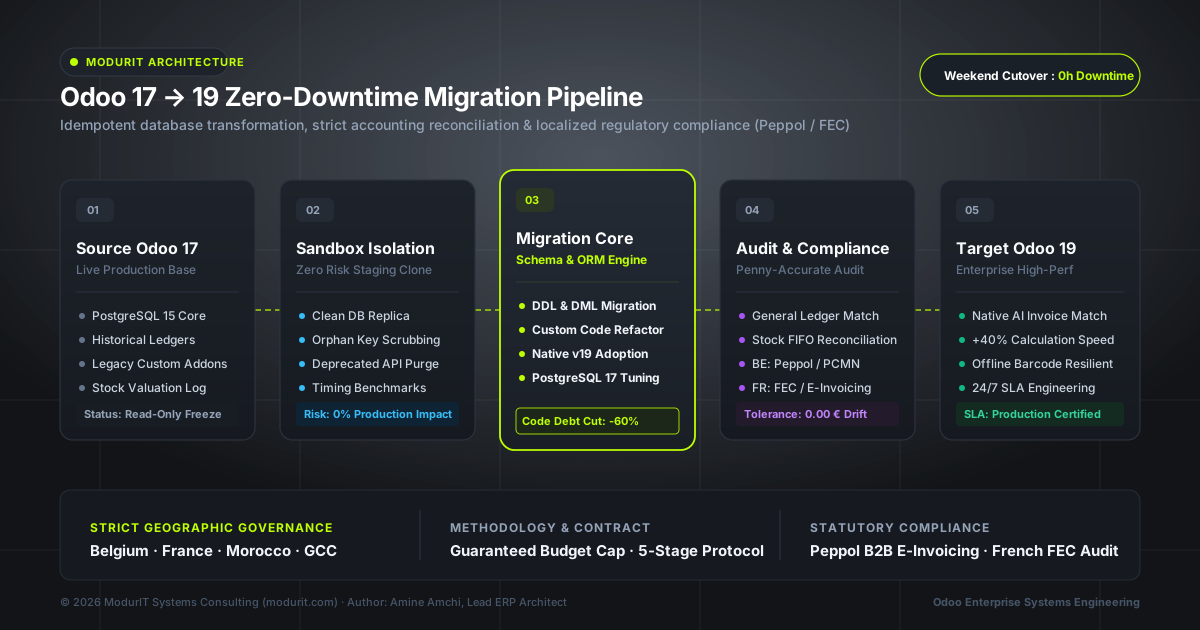
In this definitive playbook, we unpack the technical realities of transitioning from Odoo 17 to Odoo 19: how database schemas evolve, where third-party modules fail, and how Modurit’s 5-stage cutover protocol ensures your warehouse keeps shipping and your accounting remains balanced to the cent.
While Odoo 17 established a strong modern UI foundation, Odoo 19 fundamentally restructures background performance, multi-company accounting calculation loops, and native intelligent automation.
General ledger queries, aged receivable calculations, and trial balances are optimized natively in PostgreSQL, eliminating loading lag for organizations with hundreds of thousands of transactions.
Odoo 19 incorporates deep learning OCR models that automatically parse vendor bills, identify line-item tax rates, and auto-match supplier invoices against purchase orders without expensive third-party APIs.
Multi-warehouse picking, internal transfers, and batch replenishment handle spotty warehouse Wi-Fi gracefully, caching transactions locally and reconciling physical stock upon re-connection.
Odoo 19 enforces stricter database constraints on journal entry reconciliation. If historical entries in Odoo 17 contain orphaned tax lines or unresolved roundings, generic migration scripts will fail or produce balance sheet discrepancies.
Community modules built for version 17 often rely on deprecated Python ORM methods. Migrating without refactoring leads to server crashes during checkout, delivery slip generation, or invoicing.
Automated inventory valuation (AVCO / FIFO) recalculates landed costs differently across versions. Without automated test verification, reported cost of goods sold (COGS) can diverge significantly from physical warehouse asset values.
We treat your database like a living organism. Our phased engineering workflow eliminates surprises before your production cutover date.
We run automated scripts against your PostgreSQL database to locate corrupted records, unlinked foreign keys, and deprecated modules before writing a single migration line.
We clone your exact production environment into an isolated testing sandbox, execute the migration end-to-end, and benchmark report generation times.
Your finance and logistics directors compare trial balances and stock valuation reports between version 17 and version 19. Not a single cent may differ.
Friday 18:00: live database snapshot is captured. Sunday 14:00: Odoo 19 is deployed, verified, and sealed. Monday 08:00: your staff logs in normally without missed orders.
Senior architects remain on live standby for 30 days post-cutover. Includes short video cheat sheets for your staff to master Odoo 19 shortcuts quickly.
Let’s run a non-destructive audit of your current Odoo database to scope costs and migration risks with precision.
Review your current Odoo version, database volume, and custom extensions with a principal systems architect. No sales pitch—just clear architectural counsel.